DANIEL RHODES
For educational purposes only - always consult a licensed engineer for project-specific design decisions.
INTRODUCTION
The job of a truss designer involves more than simply ensuring that the trusses follow the building plans and can carry the necessary loading. The designer must consider not only material efficiency and cost, but also the time spent by the people who manufacture the finished product. A design that satisfies all structural requirements may still introduce unnecessary complexity into the manufacturing process if it is created without regard for the steps that follow.
An important principle in a process like truss design is that each person has a responsibility to make the next person’s job easier, and a poor decision made early on can have significant consequences down the line. This principle applies to most industries - food, retail, business, engineering, and others. The responsibilities and details change, but the principle remains the same.
However, many people do not recognize the importance of making the next person’s job easier. Some focus only on their own tasks or look out for their own interests; others extend that concern to their immediate team but stop there. When everyone involved, from beginning to end, is seen as one team working toward a common goal, it becomes natural to understand and account for the needs of the whole process. When the whole team works together, the task is accomplished more quickly, more easily, and more effectively. When each person thinks only about their own section, miscommunication follows, and steps must be redone or reevaluated. It is always easier to do it right the first time than to do it twice.
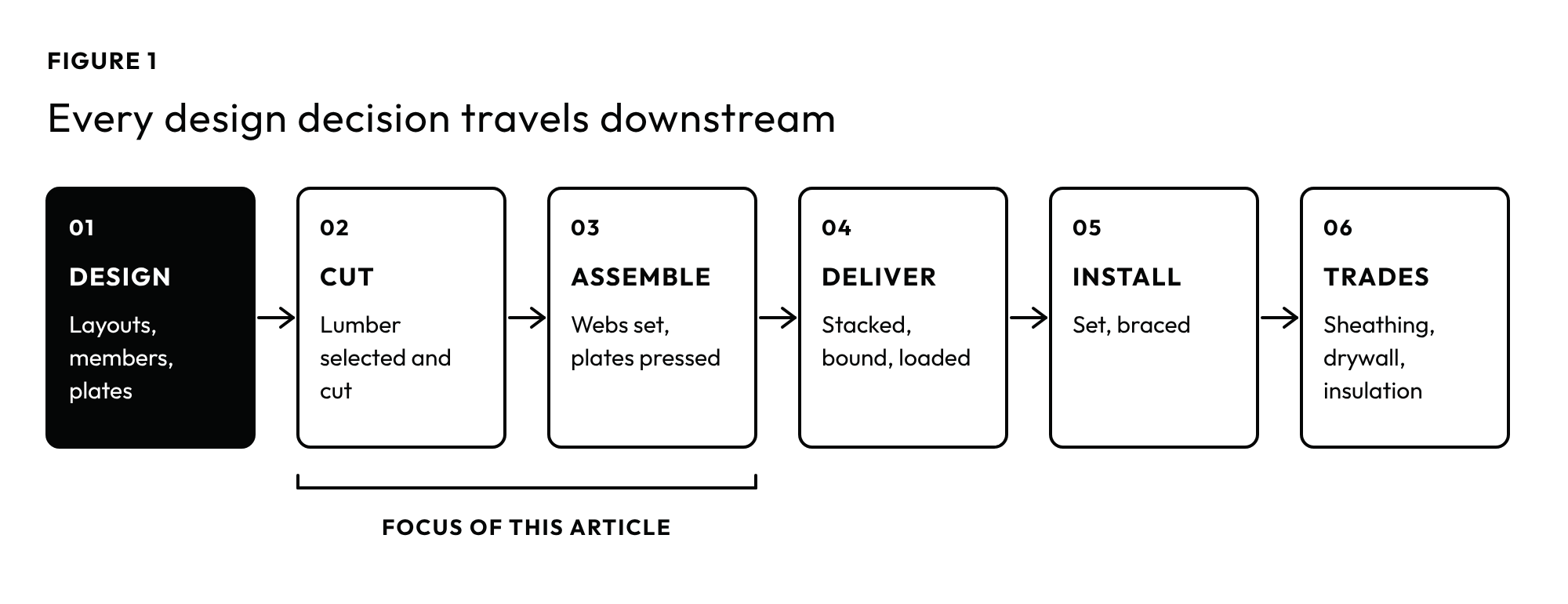
For a truss designer, this principle can be applied by understanding who interacts with the trusses and how design decisions affect them (Figure 1). During manufacturing, the members must be cut and assembled, and plates must be set and pressed. For each person involved, there are things the truss designer can do that make their job easier or harder. Trying to accommodate every preference would be impractical, if not impossible, so designers must use discernment to separate what must be done from what can reasonably be done to make each task easier. This article discusses specific ways the truss designer can make manufacturing easier.
Designing with manufacturing in mind does not mean compromising structural performance to simplify production. Rather, it means recognizing opportunities to eliminate unnecessary variation, standardize processes, and make designs easier to understand and reproduce. By considering the needs of manufacturing personnel during the design process, truss designers can help reduce production time, minimize errors, and improve overall efficiency.
OPTIMIZE FOR CUTTING
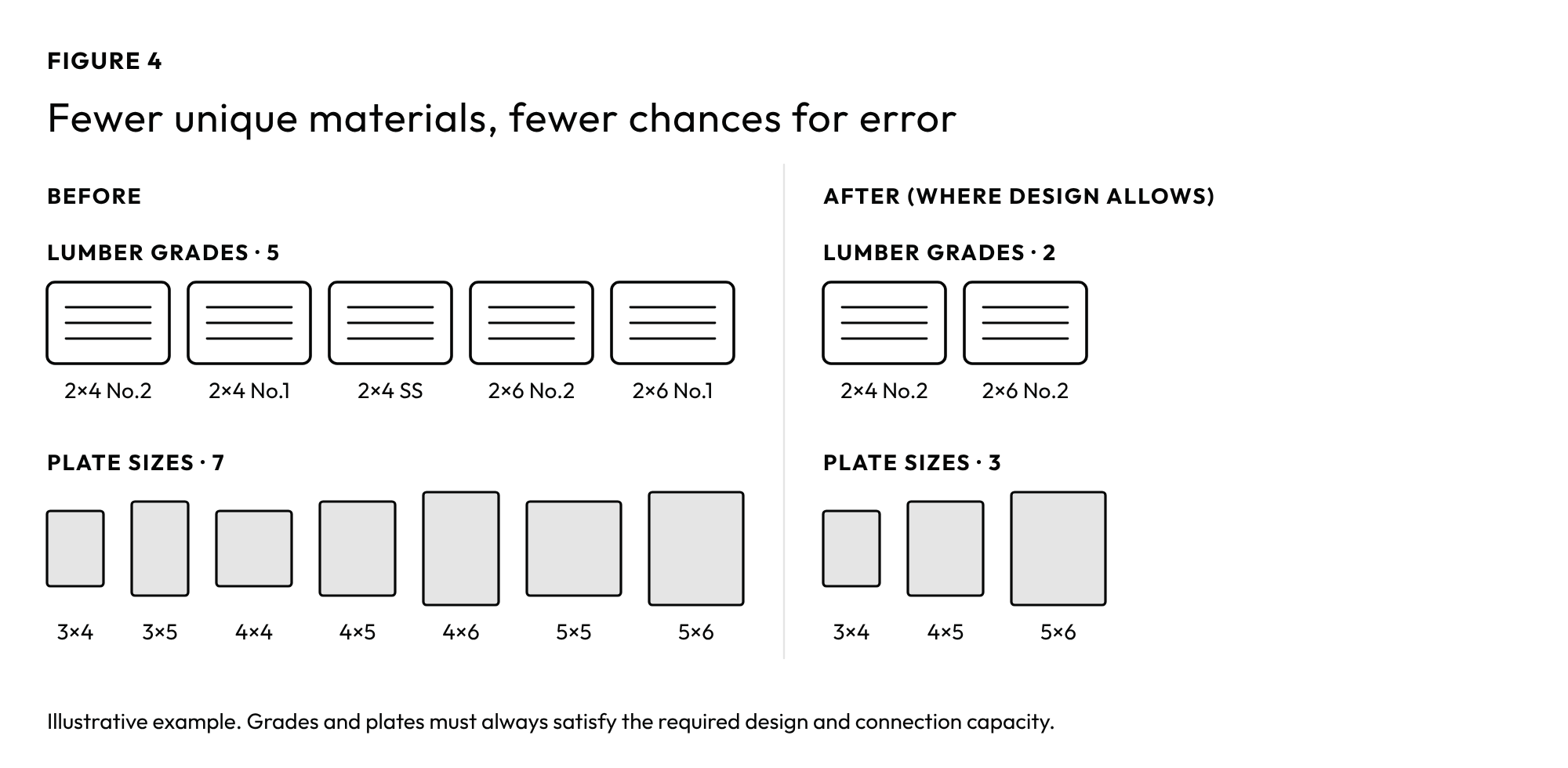
One important consideration is minimizing the number of different lumber grades required for a project. Every additional grade introduces another material that must be purchased, received, sorted, stored, and retrieved during production. When structurally permissible, consolidating lumber grades across multiple trusses can simplify inventory management and reduce the likelihood of material selection errors. This same principle applies to lumber dimensions and species: unnecessary variation should be avoided whenever possible.
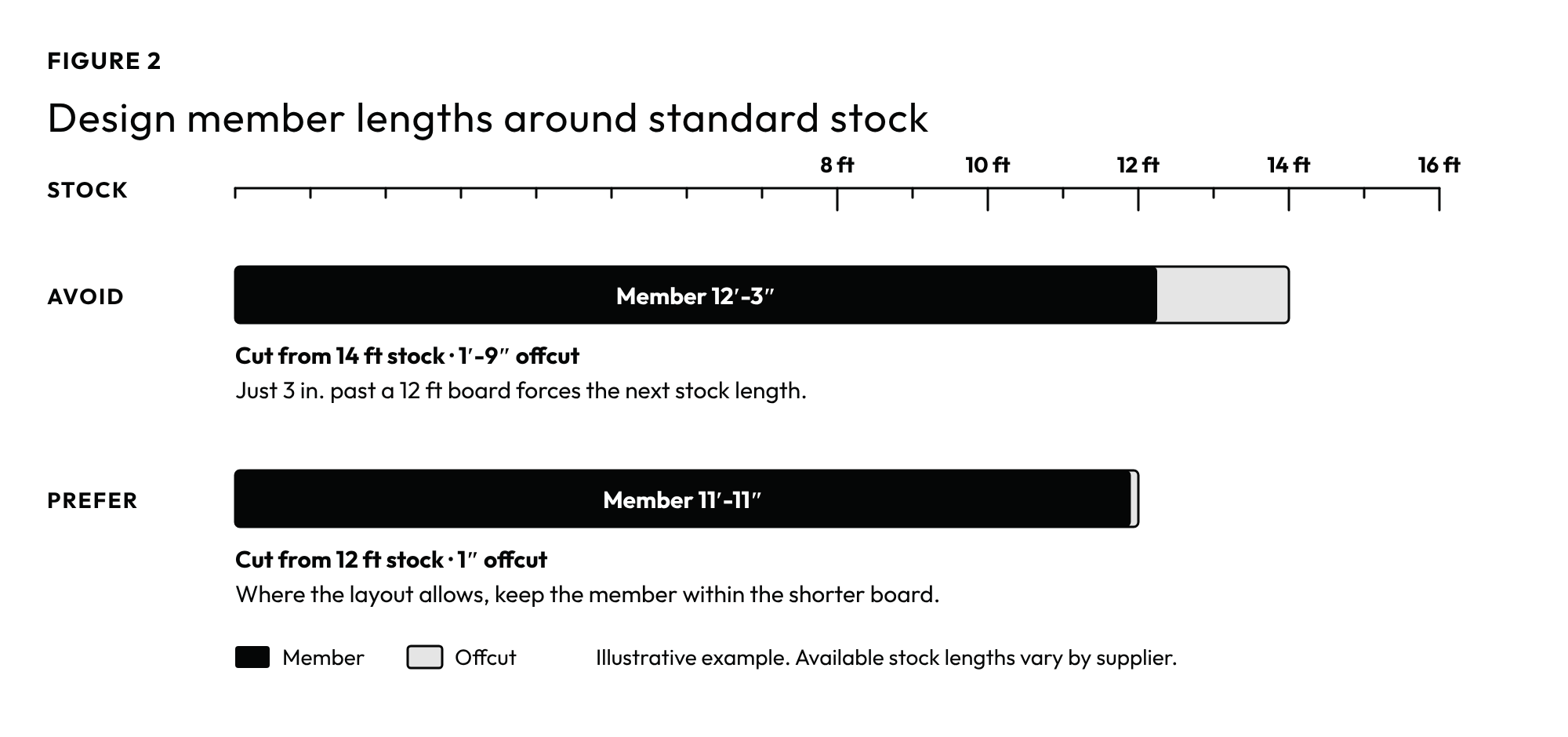
Member lengths should also be considered in relation to commonly available lumber stock lengths (Figure 2). Designing members around standard material dimensions can reduce waste and eliminate situations where a relatively small increase in member length requires the use of a significantly longer piece of lumber. Designers should also consider opportunities to optimize lumber utilization across the entire project rather than evaluating each truss independently.
Finally, consistent truss identification is essential. Establishing a standardized naming convention makes it easier to correctly group the trusses in batches before cutting and ensures that information is consistent between engineering drawings, cutting lists, and production documents. Clear identification reduces confusion and helps to batch the trusses in a convenient order.
OPTIMIZE FOR ASSEMBLY
After the individual lumber components have been cut, they must be assembled into complete trusses. At this stage, consistency and standardization become particularly important. Assemblers benefit from designs that are simple and repeatable.
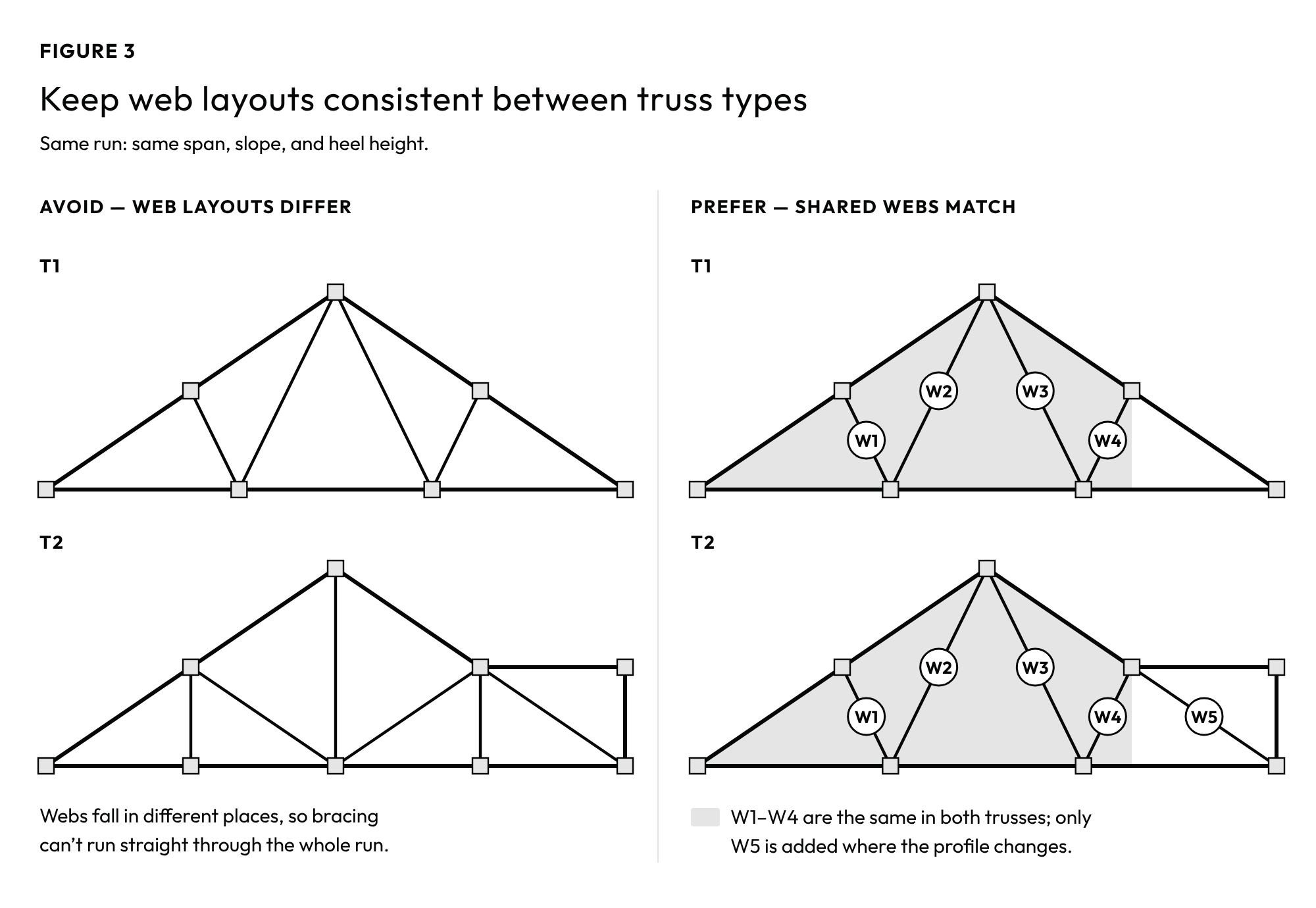
One of the most effective ways to simplify assembly is to reduce the number of unique truss configurations within a project. When structurally permissible, similar trusses should use consistent member arrangements and dimensions. Fewer unique designs means less time spent setting up the truss table and more time spent building trusses.
Maintaining consistent web configurations between similar trusses is another valuable practice. Trusses in the same run share the same span, slope, and heel height, even when their shapes differ. Where two truss types share part of the same profile, as the trusses in Figure 3 do everywhere except the right end, the webs in that portion should match. This simplifies manufacturing and places the webs in the same location in every truss, so they can be braced continuously in the field. For more on this topic, see “Optimizing Roof Trusses for Bracing,” also from Shored Design.
Connector plate selection should also be considered during the design process. Minimizing the number of unique plate sizes used throughout a project can simplify plate inventory, organization, and selection during assembly (Figure 4). Where connection requirements allow, using common plate dimensions across multiple joints can reduce the number of different materials that assemblers must manage. However, plate standardization must never compromise the required connection capacity or applicable design criteria.
CONCLUSION
The design of a wood roof truss has consequences that extend well beyond the engineering calculations used to establish its structural performance. Every decision made during the design process influences the work required of the people responsible for cutting and assembling the finished product. By considering these downstream processes, designers have an opportunity to improve not only the efficiency of individual manufacturing operations but also the performance of the entire production process.
Reducing unnecessary material variation, standardizing truss configurations, and maintaining consistent identification conventions are all practical ways to make production easier.
The underlying principle is simple: each person should make the next person’s job easier. A successful design is not merely one that meets its structural requirements, but one that can be manufactured efficiently and consistently. When designers take responsibility for the impact their decisions have on downstream operations, they contribute to a more effective manufacturing process and a better overall product.